
Depth and Complexity Critical Thinking Literary Mini-Books
5.0 (337 reviews)This resource includes 11 individual mini-books (one for each element of critical thinking-) that can be used with ANY novel. The mini-books measure about 5 x 7 inches, contain 3-5 pages, and can be glued into an interactive notebook or lapbook. They can be used as a concluding project once student
- Grade
- Grade 4, Grade 5, Grade 6, Grade 7, Grade 8
- Pages
- 59
- Answer key
- N/A
- Teaching duration
- Yearlong Resource
- Digital download
Description
This resource includes 11 individual mini-books (one for each element of critical thinking-) that can be used with ANY novel. The mini-books measure about 5 x 7 inches, contain 3-5 pages, and can be glued into an interactive notebook or lapbook. They can be used as a concluding project once students have finished a novel, or they can be completed based on smaller reading selections within a book (chapters, pages, etc.). Each of the 11 books comes with detailed teaching notes.
$AVE: Get this and several other resources in my Critical Thinking MEGA BUNDLE!!!
The topics/concepts that are covered are as follows:
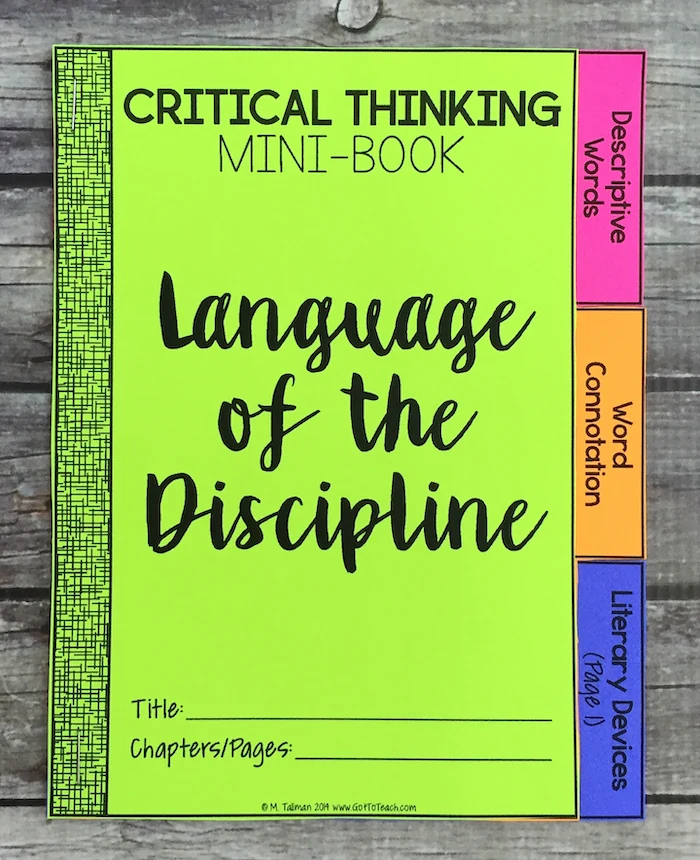
•Language of the Discipline: descriptive words, word connotation, literary devices
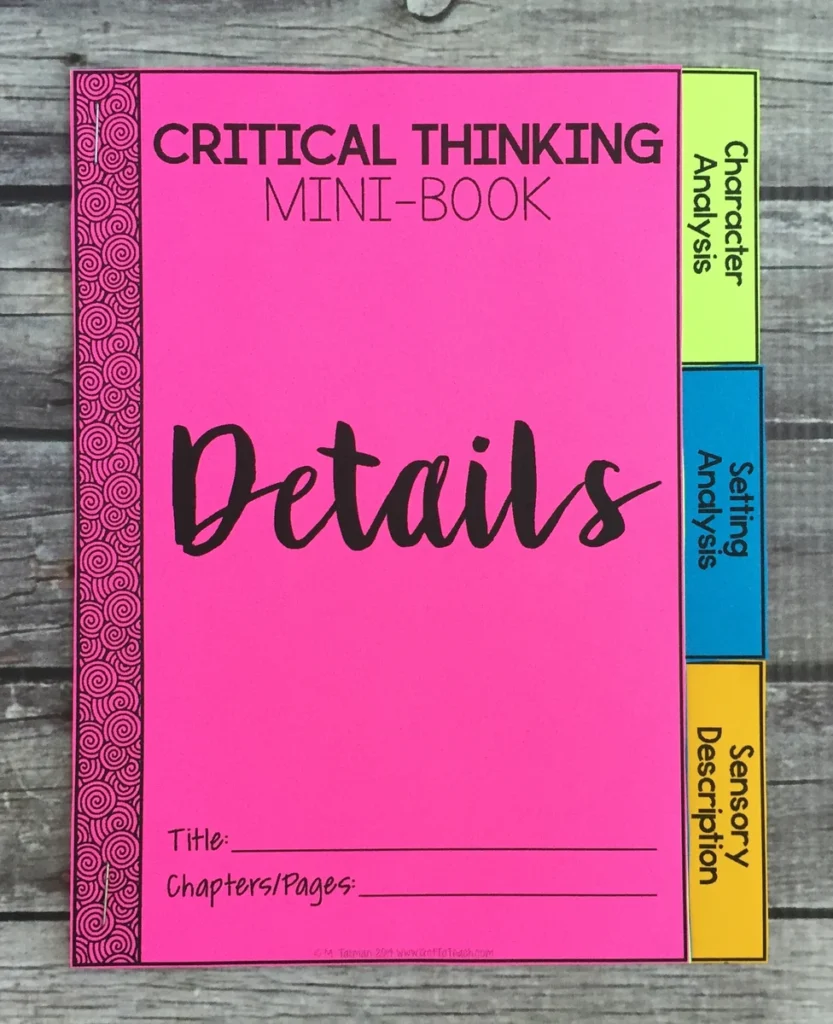
•Details: character and setting analysis, sensory description
•Patterns: exposition, rising action, climax, falling action, resolution
•Rules: character relations, theme, rules within a story
•Trends: character types, compare and contrast with nonfiction, influence of setting
•Unanswered Questions: author’s purpose, examples of ambiguity, human nature
•Ethics: plot dilemma, ethical elements, controversy and debate
•Big Idea: summarization, theme, literary archetypes, literary motif
•Relate Over Time: changes in character and setting, historical relevance, future implications
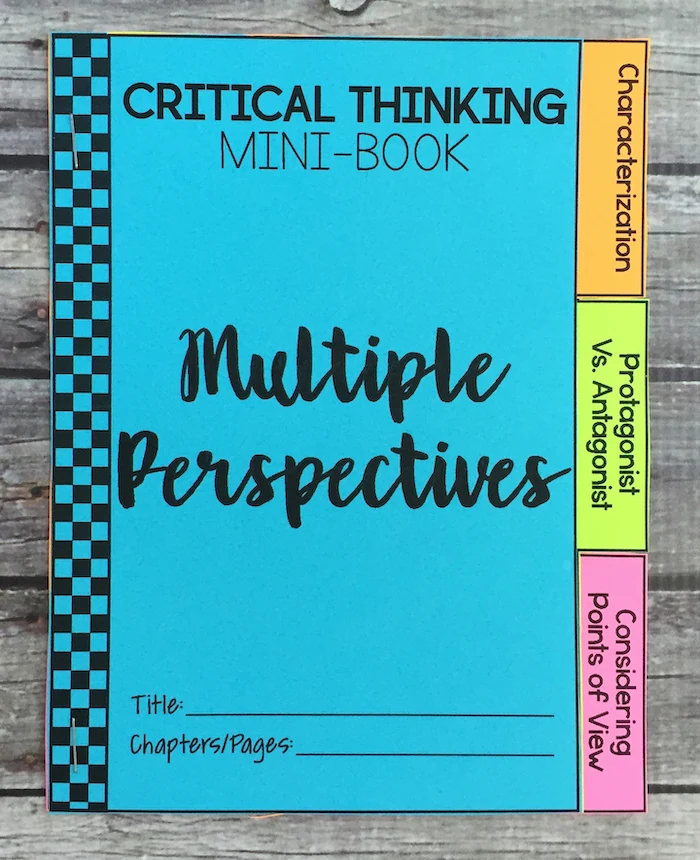
•Multiple Perspectives: characterization, protagonist vs. antagonist, point of view
•Across Disciplines: multidisciplinary connections, illustration, research
Two versions–with and without icons–are now included!!
➡FREE Depth and Complexity Posters
This resource was created based on the Depth and Complexity framework, which was created by Dr. Sandra Kaplan under the auspices of the U.S. Department of Education’s Office of Educational Research and Improvement: 1996
Get all the latest Teacher Thrive news!
➜FOLLOW me on Teachers Pay Teachers!
➜FOLLOW me on TeacherThrive.com!
Please read: This is a nonrefundable digital download. Please read the description carefully and examine the preview file before purchasing.
© Copyright 2018 M. Tallman. All rights reserved. Permission is granted to copy pages specifically designed for student or teacher use by the original purchaser or licensee. This is intended to be used by one teacher unless additional licenses have been purchased. The reproduction of any other part of this product is strictly prohibited. Copying any part of this product and placing it on the Internet in any form (even a personal/classroom website) is strictly forbidden. Doing so makes it possible for an Internet search to make the document available on the Internet, free of charge, and is a violation of the Digital Millennium Copyright Act (DMCA).
Reviews
Showing 26–30 of 374 reviews
Clever Visual Approach, But Not My Favorite
The sketch-note style brings a creative visual twist to prefixes and suffixes, which I can appreciate in theory. However, the doodle-heavy format isn’t quite my cup of tea. The content seems well-designed and could work well for visual learners, but personally, it didn't click with me.
Creative Concept, Just Not My Jam
The visual layout and doodle-style sketch notes are undeniably creative and well-executed, but the heavily visual format still didn’t resonate with my preferences. I appreciate the effort behind it and can see how it might engage visual learners, yet, personally, it didn’t click for me.
Creative Concept, But Not Quite for Me
The sketch notes are a creative approach and seem to work well for visual learners, but the doodle-heavy format just isn’t my style. The content is solid, and I can see the appeal for some classrooms, but overall it didn’t really win me over.
Would recommend for 6th grade
I purchased this as 5th grade homework/morning work, however even the first few weeks cover things like exponents, multiplying and dividing decimals, etc. that we will not get to until later in the year. I think it would work well for 6th grade as it reviews 5th material.
<p>Hello, Andrea! Thanks for taking the time to leave a review. </p><p>This resource is not designed around a particular scope and sequence since many teachers follow different timelines.</p><p>Since Daily Spiral Reviews cover all standards, students are exposed to concepts they may not have had formal instruction on. Unfamiliar content presents a great opportunity for you to build background knowledge and assess where your students are before you even teach a specific lesson.</p><p>The best way to use this spiral review is to begin with whole-group lessons where you model and discuss each activity. I don't worry too much if there haven't been formal lessons on a particular concept; I treat those items more as a preview. After a few weeks, the students really start grasping the format, and you can begin to transfer the workload to them. Eventually, when the students work independently on the review, you will spend time correcting and discussing their work in class. </p><p>As mentioned above, students will encounter concepts they are unfamiliar with. This is a GOOD thing, I promise! We don't always have the answers or know the procedures to solve problems. It's healthy to expose students to "unknowns"; they become less sensitive to the uncomfortable feeling of "not knowing" and are less likely to panic.</p><p>However, you can always use the editable version (open in PowerPoint) to remove/change any review items you like. Thanks for reaching out! </p>
Nonfiction Problem and Solution Resource for Advanced or Upper Elementary Students
I tried using this nonfiction problem and solution resource with my third graders. It has great materials, but it’s definitely better suited for more advanced students or upper elementary. With some modifications, it could work well for younger learners too.
Questions & Answers (9)
Have a question about this resource? Log in to ask a question.
Hello!
I LOVE these resources. I received the critical thinking booklets and the depth and complexity booklets. My download only had instructions/teaching notes for the critical thinking booklets. Do you have a separate set of instructions for the depth and complexity mini-books- that is what I originally wanted the most. Thanks!! Blessings!
Hi Steve! Thank you for reaching out! I'm not quite sure I understand. This is one single resource. Everything should be titled Critical Thinking Literary Mini-Books.
Sorry, I just sent another question but I have just one more. Does this product and your Depth and Complexity Critical Thinking Literary Response Booklet have a lot of overlap or do they dovetail nicely? Just not sure if I should buy both and combine them for my high fliers or find something else to supplement their workbooks. Thanks again!
There is some overlap, but most of the content is unique.
Hi there, Can these be printed, so each page is one full-sized piece of paper? Or can they be combined to make one large novel-study response booklet rather than separate mini-books?
Thanks so much!
Hello! They cannot be printed on one page.
Do the pages fold to make the booklet? Or does each section need to be individually cut?
Hi Ruth!
The pages are cut out and then used to assemble the books.
I am having trouble printing the file because it indicates it is "protected." I have had to send it to my email and print it from my email. It should allow me to print from the downloaded file. This is not just an isolated event on one computer. It will not print on any computer unless it is in my email and I open it from there. Any ideas?
Hello! Please make sure you are opening and printing the file from the latest version of Adobe Reader. If you are still having issues, please contact TpT. https://www.teacherspayteachers.com/Contact
Hi! Should I model reading aloud a chapter book (example Wonder) and doing one example from one of the tabs each day so that students can then apply the skill to their own book of choice or book club book? I saw the fairytale example and wasn't sure which to purchase to introduce this to our students while following the hope and sequence for 7th grade. Also is this geared for GT students verses regular students? I teach both (in separate periods)
Hi Simone! If your students are new to Depth and Complexity, I recommend starting with the fairytale unit. This unit has everything you need to explicitly teaching the 11 elements of Depth and Complexity. Once you finish that unit, then using the mini-books will be a perfect activity for your students, or for you to used as a guided reading activity.
Could you please provide pictures or descriptions of what the pages look like inside each booklet? I don't quite understand how the students use them. Thank you!
Hello! The preview has a sample of one of the books and the teaching notes.
Do you have any of these to go along with high school fiction novels? I am looking for higher level. Any help would be greatly appreciated!!
Hi Jenna! I am sorry, but I do not. Thank you for your interest.
Are the pages editable?
Hi Colleen. Thanks for asking. No, this resource is not editable.
