
5th Grade Grammar Unit: Commas and Introductory Elements
4.9 (181 reviews)This resource includes everything you need to teach your students to use a comma to separate an introductory element (e.g., words, phrases, clauses) from the rest of a sentence. Now Included: Google Forms for the Practice Printable, Task Cards, and Assessment! What’s Included: PowerPoint Lesson…
- Grade
- Grade 5
- Subject
- Grammar
- Pages
- 40
- Answer key
- Included
- Teaching duration
- 1 Week
- Digital download
- PDF, PowerPoint, and Excel (ZIP)
Description
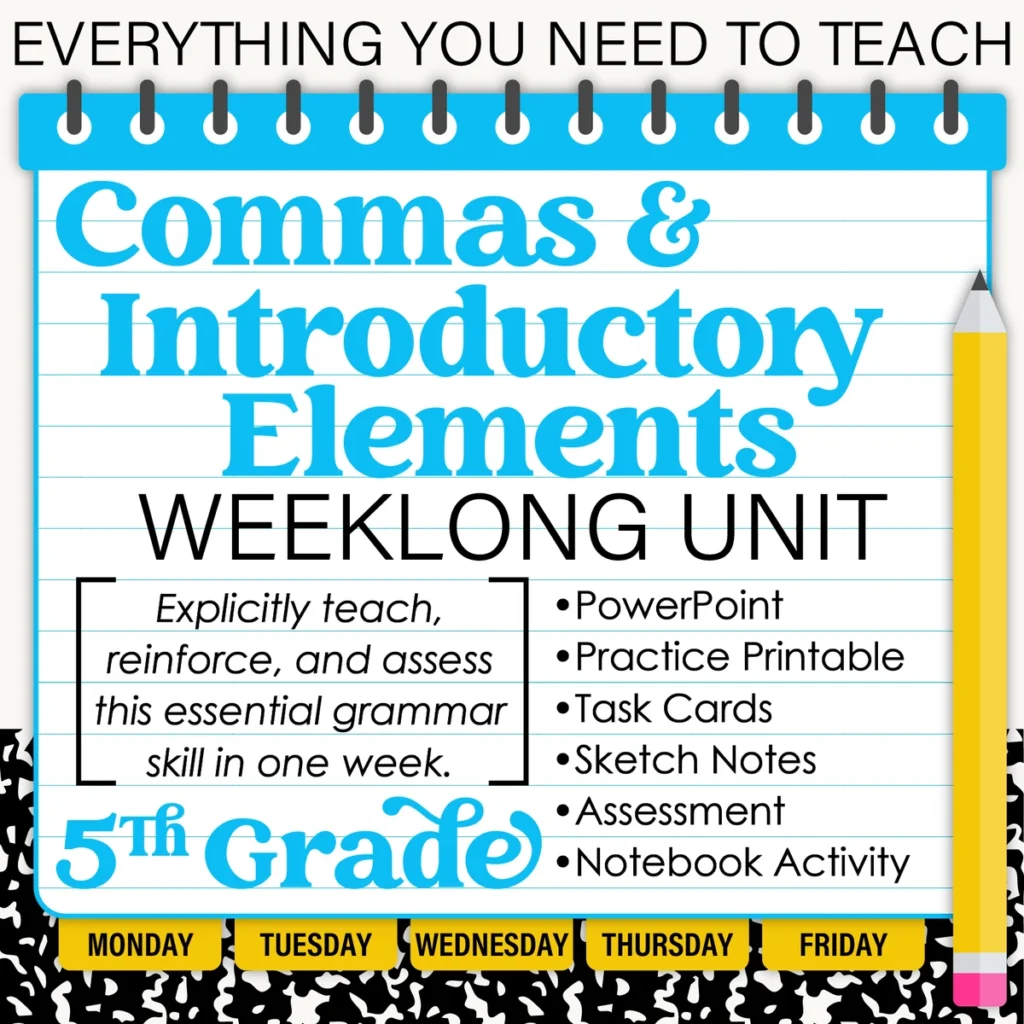
This resource includes everything you need to teach your students to use a comma to separate an introductory element (e.g., words, phrases, clauses) from the rest of a sentence.
Now Included: Google Forms for the Practice Printable, Task Cards, and Assessment!
What’s Included:
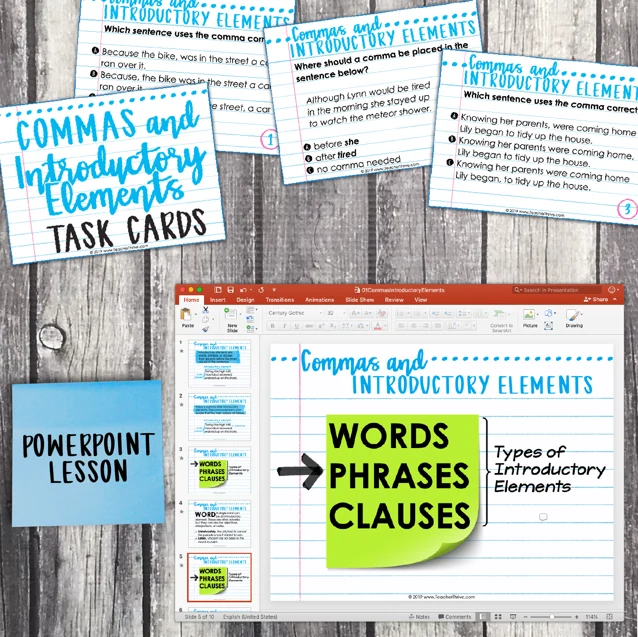
- PowerPoint Lesson (Monday)
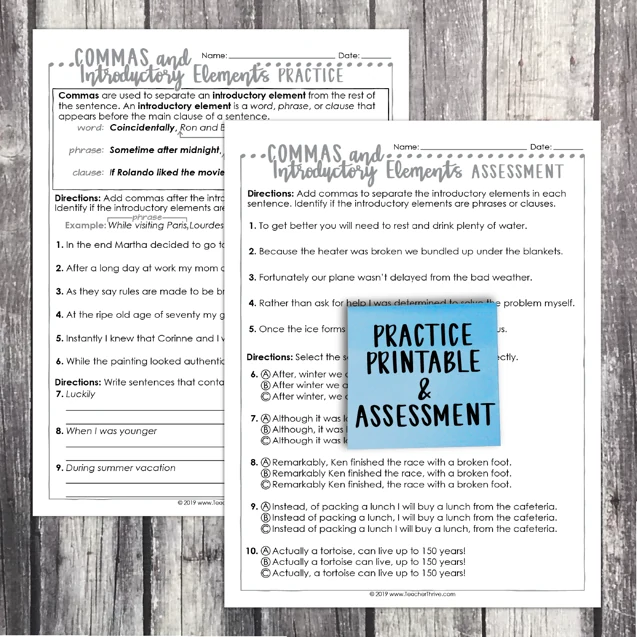
- Practice Printable – Digital Version Included (Tuesday)
- 30 Task Cards – Digital Version Included (Wednesday)
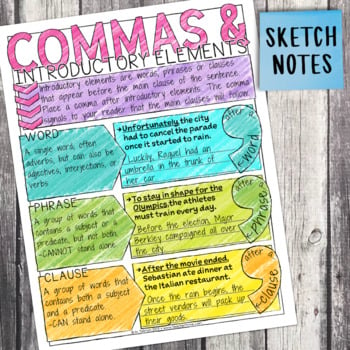
- Sketch Notes (Thursday)
- Assessment – Digital Version Included (Friday)
- BONUS: Interactive Notebook Activity
Download the preview for a detailed overview of the resource.
CLICK HERE for the entire Fifth-Grade Grammar Bundle!
Fifth Grade Grammar Units:
- Parts of Speech Review
- Subject and Predicate
- Coordinating Conjunctions
- Compound Sentences
- Subordinating Conjunctions
- Complex Sentences
- Simple, Compound, or Complex Sentences
- Prepositions
- Prepositional Phrases
- Interjections
- Perfect Verb Tenses
- Using Verb Tenses
- Shifts in Verb Tense
- Correlative Conjunctions
- Commas in a Series
- Commas and Introductory Elements
- Commas for Yes/No, Tag Questions & Direct Address
- Titles of Works: Quotations, Underlines & Italics
- Expand Sentences
Coming Soon:
- Combine Sentences
- Reduce Sentences
- Compare Dialects
- Compare Registers
- Context Clues
- Roots and Affixes
- Use Reference Materials
- Similes and Metaphors
- Idioms, Adages, and Proverbs
- Word Analogies
- Signal Words
Get all the latest Teacher Thrive news!
➜FOLLOW me on Teachers Pay Teachers!
➜FOLLOW me on TeacherThrive.com!
Please read: This is a nonrefundable digital download. Please read the description carefully and examine the preview file before purchasing.
© Copyright 2018 M. Tallman. All rights reserved. Permission is granted to copy pages specifically designed for student or teacher use by the original purchaser or licensee. This is intended to be used by one teacher unless additional licenses have been purchased. The reproduction of any other part of this product is strictly prohibited. Copying any part of this product and placing it on the Internet in any form (even a personal/classroom website) is strictly forbidden. Doing so makes it possible for an Internet search to make the document available on the Internet, free of charge, and is a violation of the Digital Millennium Copyright Act (DMCA).
Reviews
Showing 371–374 of 374 reviews
I love this idea, but some of the sentence frames don't seem to make sense - "something common is very small," "someone who is dangerous lacks love," "something large is very enormous" (should be the other way around?), "a foot sleeps/rests in a person," "hot is an antonym for warm". Or is it me? I haven't used this sort of thing before!
Hello! I think you may be misunderstanding the process of writing bridge sentences. If the bridge sentence doesn't make sense, such as the examples you provided, then that is how you know the word pair doesn't match the key words.
First, I truly appreciate the work that went into this product. However, I am extremely disappointed that I wasted the money on this item. If there was a way to get my money back and return it, I would. To me, this is an unusable product, because it covers the exact same content every week. I thought it would vary throughout the year to expose learners to different grammatical concepts.
Now this was a good product to purchase
I think these skills are really tough for my 6th graders, I asked a question of the author but didn't receive an answer.
<p>Hi Gretchen. I never received your question. Did you email me? I would love to help in any way I can. Melissa info@teacherthrive.com</p>
Questions & Answers (4)
Have a question about this resource? Log in to ask a question.
Hello, I am correcting my assessments and struggling with question 1. The answer key says that the introductory element, "To get better," (sentence 1) is a clause. Can you tell me why this is true? To me, it mirrors the "To get in shape for the Olympics," phrase from the PowerPoint. Nothing like being humbled by 5th-grade grammar! :) Thank you.
Hello, Laura! Thank you so much for bringing this to my attention. This was an error in the assessment answer key. It should have been labeled "phrase." I apologize for this inconvenience.
Hello, I just went through the PowerPoint for this lesson with my students, and there are a couple of mistakes on Slide 10 that I wanted to inform you of:
"In the spring, we will plant strawberries in garden." -there needs to be a word before garden like "our garden," "the garden," etc.
and
"Surprisingly, the sugar-free desserts where delicious." -it should be "were" not "where"
Hello! Thank you so much for bringing this to our attention. We have corrected the errors and apologize for the inconvenience they caused you.
Hi, I am having difficulty with the digital version of the task cards. I made a copy and assigned in my student's google classroom. They completed the task and submitted it but they cannot see their accuracy and their score does not show up for me. I am rather new using google classroom so hoping you can maybe help. I have purchased several of these from you. Thank you.
Hi There! Please check out this short video tutorial that will walk you through the steps: https://youtu.be/hNqZElFIQ3I
In your sketch notes, you've stated that an introductory clause can stand alone. However, the examples you give begin with dependent clauses, and these cannot stand alone. I may have misunderstood the notes...could you clarify this for me? Thanks!
