
Depth and Complexity Novel Study for Hatchet
4.9 (370 reviews)Reading and Responding to Hatchet with Depth and Complexity!Bring your students’ thinking and discussion to a whole new level while reading Gary Paulsen’s Hatchet. This critical thinking companion resource is designed to “dig deeper” when compared to traditional novel worksheets available. Each cha
- Subject
- Reading
- Pages
- 24
- Answer key
- Not Included
- Teaching duration
- 4 Weeks
- Digital download
Description
Reading and Responding to Hatchet with Depth and Complexity!
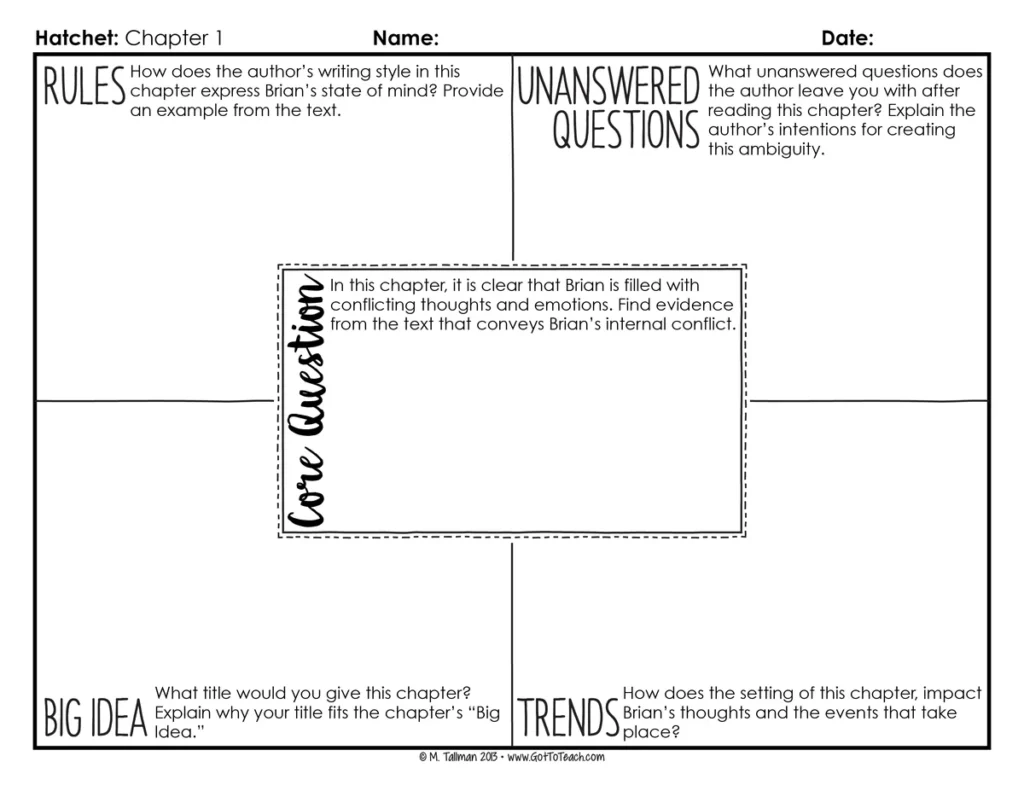
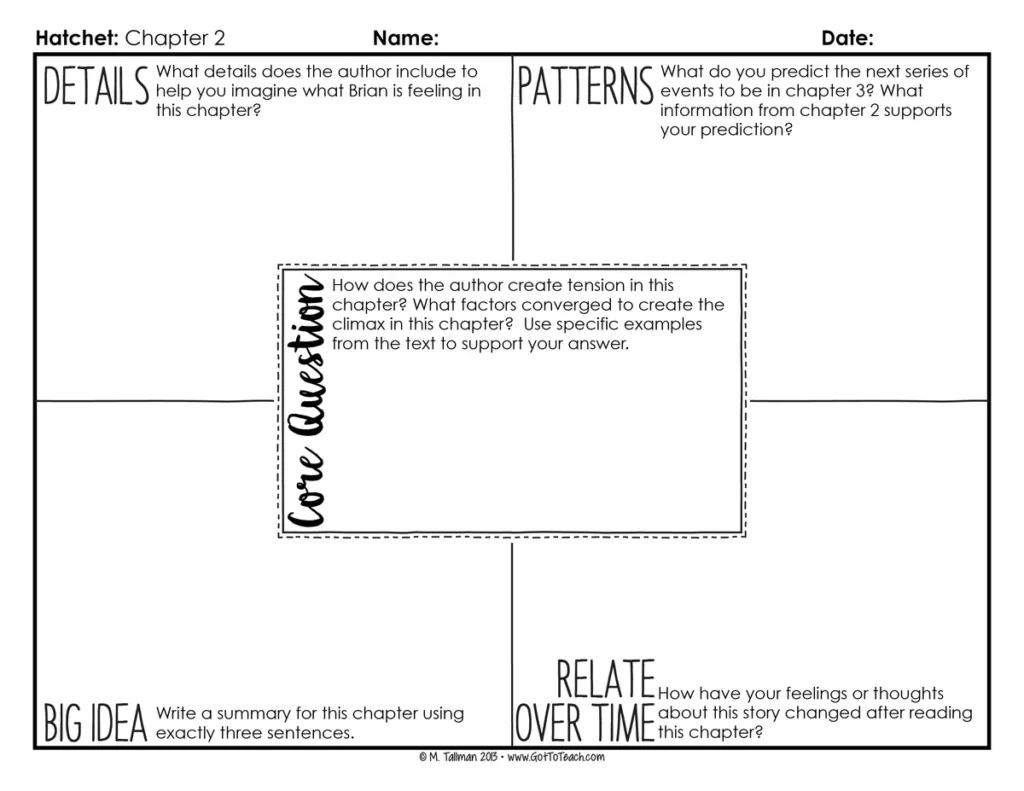
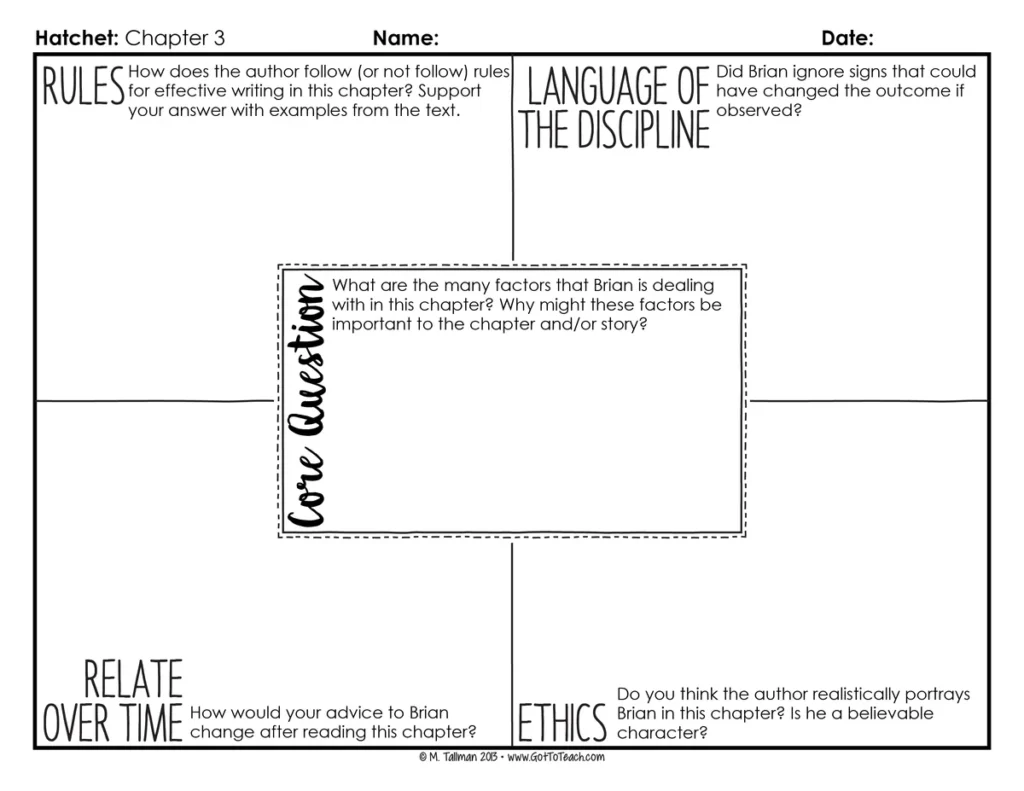
Bring your students’ thinking and discussion to a whole new level while reading Gary Paulsen’s Hatchet. This critical thinking companion resource is designed to “dig deeper” when compared to traditional novel worksheets available. Each chapter has a unique graphic organizer that contains 4 critical thinking questions questions and 1 related “Core Question”. All questions within the graphic organizers are open-ended, can be answered in multiple ways, and encourage textual support from the book.
This teaching tool can be applied in multiple ways…
*”Expert Group” Sharing
*”Jig Saw” Activity
*Whole-Class “Shared Reading”
*”Think-Pair-Shares”
*”Literature Circle” Activity
*Writing Prompts
*Assessments
➡FREE Depth and Complexity Posters
You might also like…
Critical Thinking Task Cards for Literature
Critical Thinking Task Cards for Science
Critical Thinking Task Cards for Social Studies
Teach Critical Thinking Using Fairytales
Critical Thinking Literature Circles
Critical Literary Literary Response Booklet
IMPORTANT: This resource has recently been reformatted. Please read through the product description carefully and download the preview to see exactly what is included.
This resource was created based on the Depth and Complexity framework, which was developed by Dr. Sandra Kaplan under the auspices of the U.S. Department of Education’s Office of Educational Research and Improvement: 1996
Get all the latest Teacher Thrive news!
➜FOLLOW me on Teachers Pay Teachers!
➜FOLLOW me on TeacherThrive.com!
Please read: This is a nonrefundable digital download. Please read the description carefully and examine the preview file before purchasing.
© Copyright 2018 M. Tallman. All rights reserved. Permission is granted to copy pages specifically designed for student or teacher use by the original purchaser or licensee. This is intended to be used by one teacher unless additional licenses have been purchased. The reproduction of any other part of this product is strictly prohibited. Copying any part of this product and placing it on the Internet in any form (even a personal/classroom website) is strictly forbidden. Doing so makes it possible for an Internet search to make the document available on the Internet, free of charge, and is a violation of the Digital Millennium Copyright Act (DMCA).
Reviews
Showing 11–15 of 18 reviews
I love that each chapter has a few questions that require the students to dig deeper! These are great for starting and/or finishing socratic seminars after each chapter.
Her products are always challenging and engaging! My 6th graders weren't quite at this level, but it did get them thinking deeply!
Resource was great however, there is NO answer key for the questions and it makes it difficult to make sure the kids are answering accordingly to the question asked. Rigor is GOOD.
Used this during our novel study and it was perfect!!
I used this as an extension for students looking for a greater challenge with our class novel. It was great to have a simple way to offer more to students who were reader for enrichment.
Questions & Answers (7)
Have a question about this resource? Log in to ask a question.
S
You talk about RULES for effective writing several times. When you use these 11 elements, how to you teach these rules?
Hello! Thanks for reaching out. “Rules” is one of the 11 critical thinking elements. Big Ideas, Rules, Trends, Patterns, Language of the discipline, Ethics, Relationships over time, Details, Unanswered Questions, Across Disciplines, and Multiple Perspectives.
When you refer to "rules" as one of the 14 critical thinking elements, which rules do you mean? Is there a source you are taking those 14 elements from?
KS
Hello! Thanks for reaching out. “Rules” is one of the 11 critical thinking elements. Big Ideas, Rules, Trends, Patterns, Language of the discipline, Ethics, Relationships over time, Details, Unanswered Questions, Across Disciplines, and Multiple Perspectives.
Do you have Depth and Complexity Critical Thinking Resource for any novel available?
Hi Tinahsa! I think you would be interested in our Depth and Complexity Critical Thinking Literature Circles Book Clubs resource! You can find that here:
https://www.teacherspayteachers.com/Product/Depth-and-Complexity-Critical-Thinking-Literature-Circles-Book-Clubs-660385
Do you happen to have a list of standards this resource would cover?
Hello. I don’t have a standards alignment for these units.
Would you be able to provide an answer key? or at least some description of what the answers would look like, even though they could be varied. Thanks! I want to buy this but would prefer if there was an answer key for it
Hi Jessica! Thank you for your interest. Due to the nature of the resource and time commitments, I can not provide an answer key.
I'm wondering if I can get 2 pages as examples. It doesn't seem to let me preview this item. Thanks :)
Hello! I could you email two example pages. Can you email me at GotToTeach@icloud.com
