
Science of Reading Phonics Based Reading Fluency Program
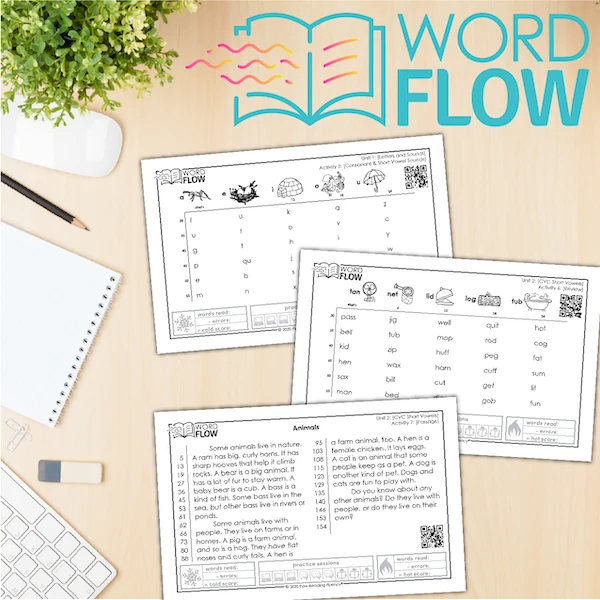
4.8 (12 reviews)Word Flow is a comprehensive phonics-based reading fluency program that is aligned with the science of reading. This program is perfect for students who are not yet ready for Level 1 (150L) of the Flow Reading Fluency program.The objectives of Word Flow are to:Develop automaticity in decoding words
- Subject
- Reading
- Pages
- 100+
- Answer key
- N/A
- Teaching duration
- Yearlong Resource
- Digital download
Description
Word Flow is a comprehensive phonics-based reading fluency program that is aligned with the science of reading. This program is perfect for students who are not yet ready for Level 1 (150L) of the Flow Reading Fluency program.
The objectives of Word Flow are to:
- Develop automaticity in decoding words according to phonics rules, syllable patterns, and etymology.
- Provide students with a systematic and developmentally appropriate framework to decode words.
- Allow teachers to provide highly-differentiated instruction to a wide range of learners.
What’s Included in Word Flow?
- 10 skills-based units
- Each unit includes 4-8 activities (70 activities total).
- 70 Assisted Reading Video Passages (QR Access)
- Comprehensive placement assessment
- Detailed implementation instructions
How Does Word Flow Improve Reading?
As with Flow Reading Fluency, Word Flow uses the following three strategies to improve decoding automaticity.
- Modeling: Students will access Assisted Reading Videos that model a wide range of phonics skills. These Assisted Reading Videos provide a powerful multi-sensory model for students as they watch, listen, and read along.
- Practicing: Students are presented with critical opportunities to practice their decoding skills that consider their Zone of Proximal Development (ZPD). Practice activities gradually progress students along a continuum of learning, where students begin with a high level of external support to a high level of independence.
- Monitoring: Throughout the program, students are actively monitoring their progress by recording and graphing the number of words they can read in one minute. This monitoring not only promotes student agency, but it is also highly motivational.
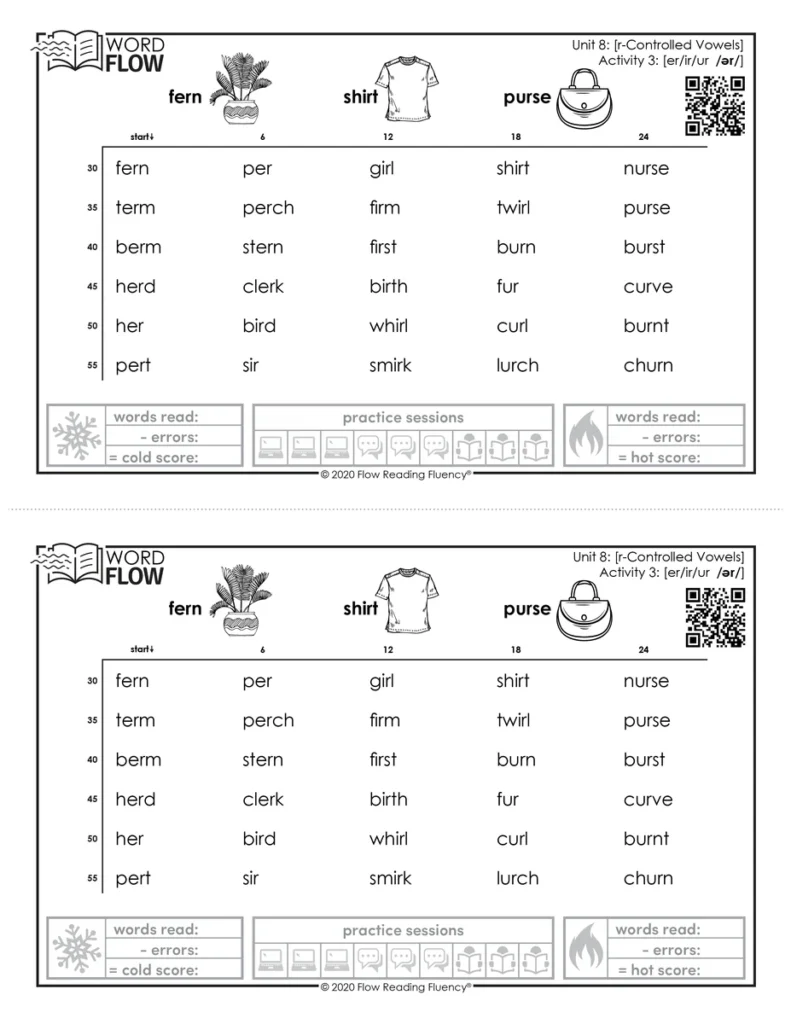
Download the preview to see a list of all the phonics skills covered and sample lists.
Stay Connected with Teacher Thrive!
➜SIGN UP for my email newsletters.
➜VISIT me on TeacherThrive.com.
➜FOLLOW me on Facebook.
➜FOLLOW me on Pinterest.
➜FOLLOW me on Instagram.
Please read: This is a nonrefundable digital download. Please read the description carefully and examine the preview file before purchasing.
© Copyright 2018 M. Tallman. All rights reserved. Permission is granted to copy pages specifically designed for student or teacher use by the original purchaser or licensee. This is intended to be used by one teacher unless additional licenses have been purchased. The reproduction of any other part of this product is strictly prohibited. Copying any part of this product and placing it on the Internet in any form (even a personal/classroom website) is strictly forbidden. Doing so makes it possible for an Internet search to make the document available on the Internet, free of charge, and is a violation of the Digital Millennium Copyright Act (DMCA).
Reviews
Showing 5361–5365 of 5,412 reviews
A great resource for Intervention!
I like the set-up, but I have to go in and change several things b/c the exercises don't require the students to do what is required of the actual Common Core standard. Ex, students do know figurative language. The Daily Language wants the students to find the origin, meaning & write a sentence. The origin is not part of the standard. I feel it's better for the students to determine the meaning using context clues (instead of just looking it up), then write their own sentence. Instead, I give them a sentence using the idiom. Then they must determine, the meaning using the context clues I've provided in the sentence. Then they must write their own sentence using the idiom. I do the same thing for the proverb/adage on the Wednesday section.
The prefix section- I change it around & have the students to identify the prefix. Determine the meaning of the prefix, then then the meaning of the word. I do understand that when creating this product, it's created to serve teachers all over that may have different standard that they must follow. I'd like to send examples of how I tweak the Daily Language.
Hello. Thank you for taking the time to leave such detailed feedback. While the origin is not part of the standard, students find this information very interesting and knowing the origin does help students retain the meaning. I will also add that the act of finding the origin is a common core standard: "Consult reference materials (e.g., dictionaries, glossaries, thesauruses), both print and digital, to find the pronunciation and determine or clarify the precise meaning of key words and phrases." I am happy to hear that you have been able to adapt this resource to meet your teaching needs, though.
Kind of high expectations before reading -- concepts are challenging for many younger students with nothing concrete from which to build references. With the right group, it would be great.
great resource
Very clear. My only suggestion would be more text structures and lines in the boxes.
Questions & Answers (3)
Have a question about this resource? Log in to ask a question.
I purchased this program, however when we try to use the QR codes, it prompts me to sign up and repurchase the program again. Can you please help me understand how my students can use the QR codes successfully?
Hello, Torie! That is very strange. I just tested out the QR codes, and the few I checked seem to work just fine. Is there a particular activity that you are having issues with? Feel free to email me at info@teacherthrive.com if you'd like to troubleshoot this directly.
I have the same question. I was also wondering if this program would be helpful for the K-2 grades, and then when they got to third I have the FRF digital that they use?
Hi Carol! Thanks for reaching out! Yes, Word Flow is geared towards students who are still decoding words but are not yet ready for Level 1 (150L), typically K-1. Students reading 150L and higher will be a perfect fit for Flow Reading Fluency Digital.
I purchased the Flow Reading Fluency digital program from the website. Is this phonics program included in that somewhere? Just wanted to ask so I don't end up paying extra for something I already might have!
Hi Kate! Thanks for reaching out. Would you mind sending us an email at flow@teacherthrive.com with the email address you created your account with?
