
4th Grade Math Subtract Mixed Numbers (Like Denominators) Doodle Sketch Notes
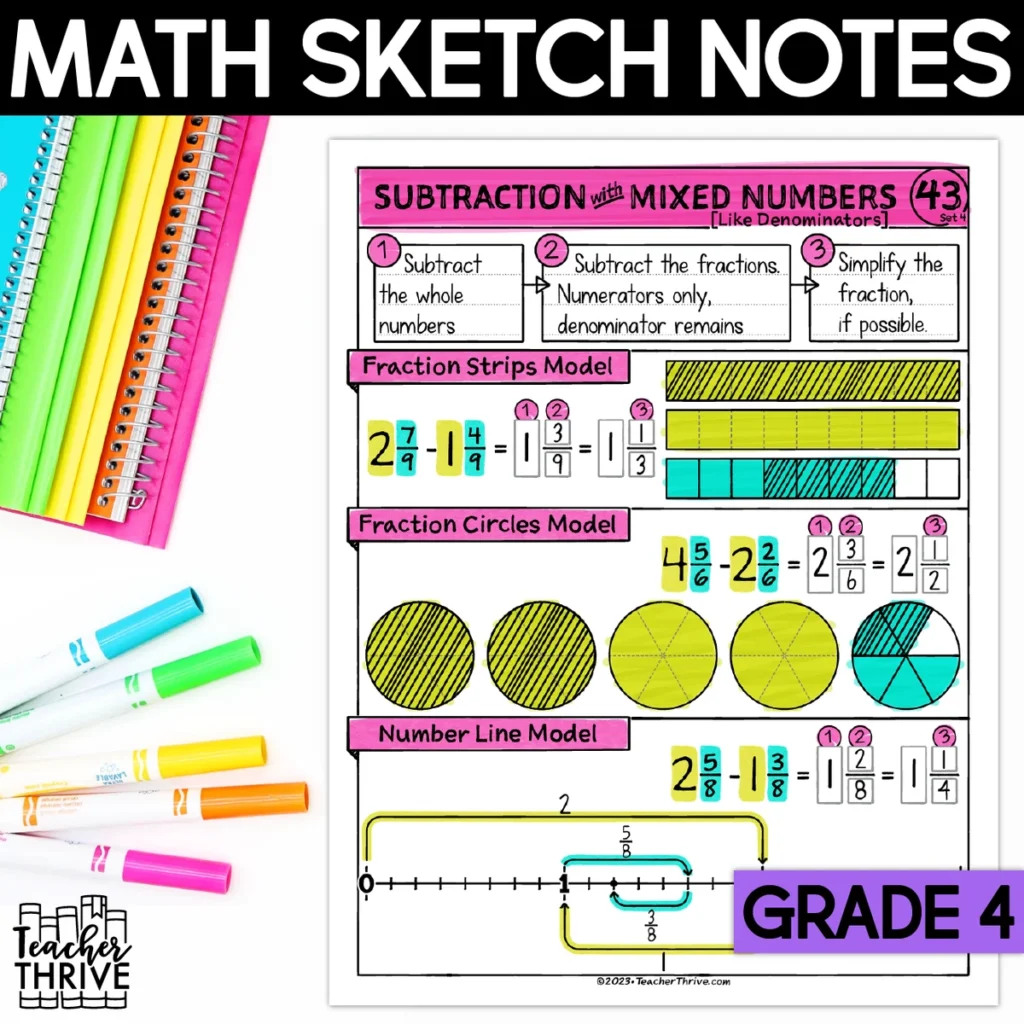
5.0 (4 reviews)These fourth grade math sketch notes (AKA doodle pages) are a powerful learning and teaching tool for subtraction with mixed numbers. This concept is illustrated with fraction strips, number lines, and the standard algorithm. These notes cover essential math concepts and procedures for students in a…
- Grade
- Grade 4
- Subject
- Math
- Pages
- 5 Pages & 72 Slides
- Answer key
- Included
- Teaching duration
- 1 hour
- Digital download
- PDF and PowerPoint
Description
These fourth grade math sketch notes (AKA doodle pages) are a powerful learning and teaching tool for subtraction with mixed numbers. This concept is illustrated with fraction strips, number lines, and the standard algorithm. These notes cover essential math concepts and procedures for students in a visually appealing way. You can use this resource to supplement any math curriculum, and they are perfect for previewing/pre-teaching or reviewing/reinforcing.
These sketch pages are like mini anchor charts that your students actively create and can be referred to in the future.
While these were specifically created for 4th grade, there are no grade-level indicators on the student materials, so you can use these with older students.
WHAT’S INCLUDED:
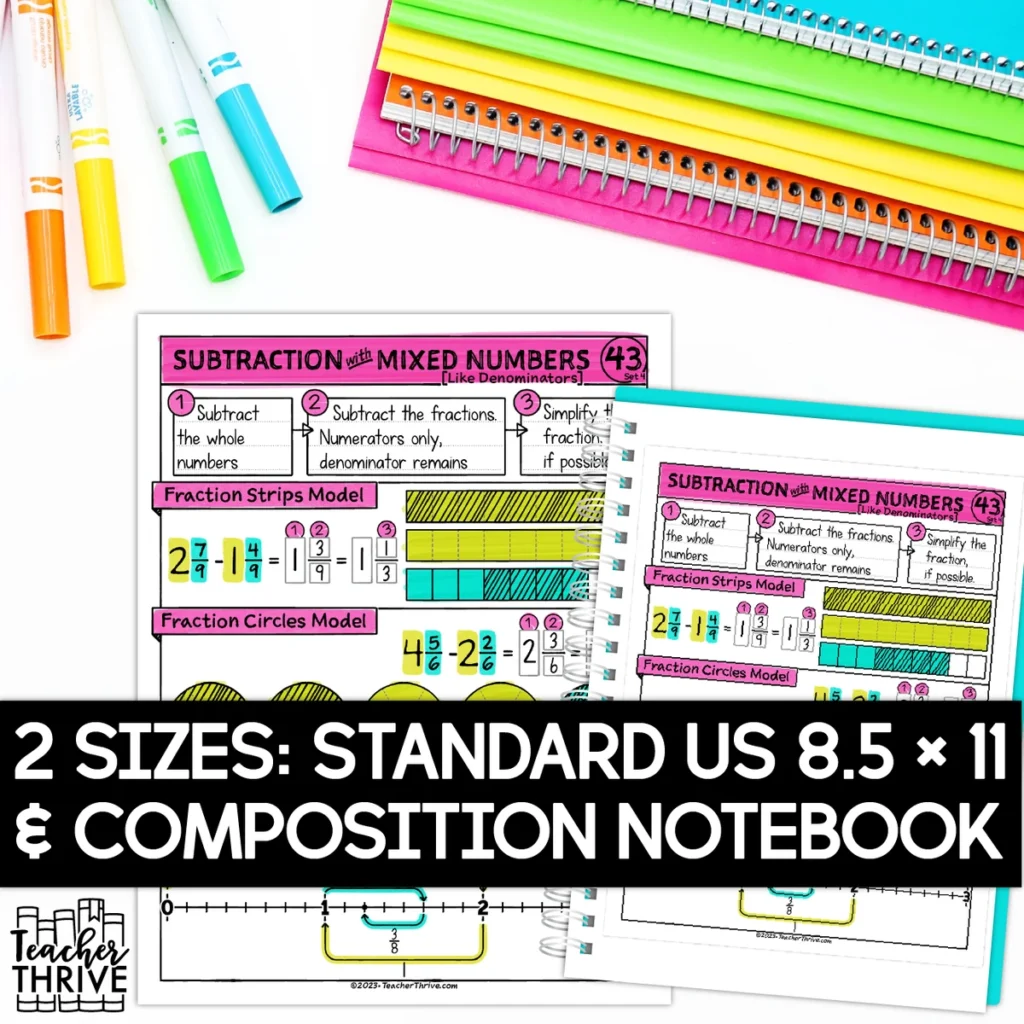
- Blank student note page (two sizes: 8.5 × 11 & composition notebook size for INBs)
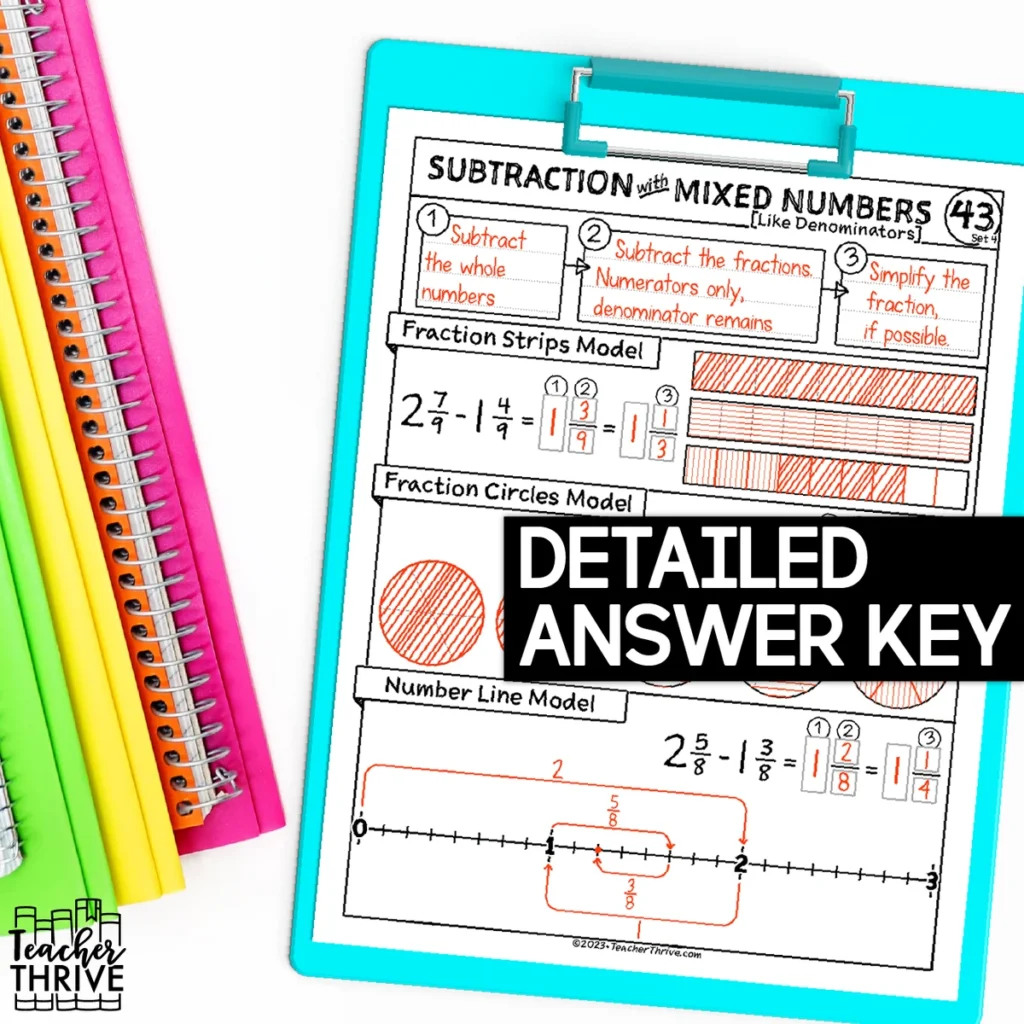
- Detailed answer key
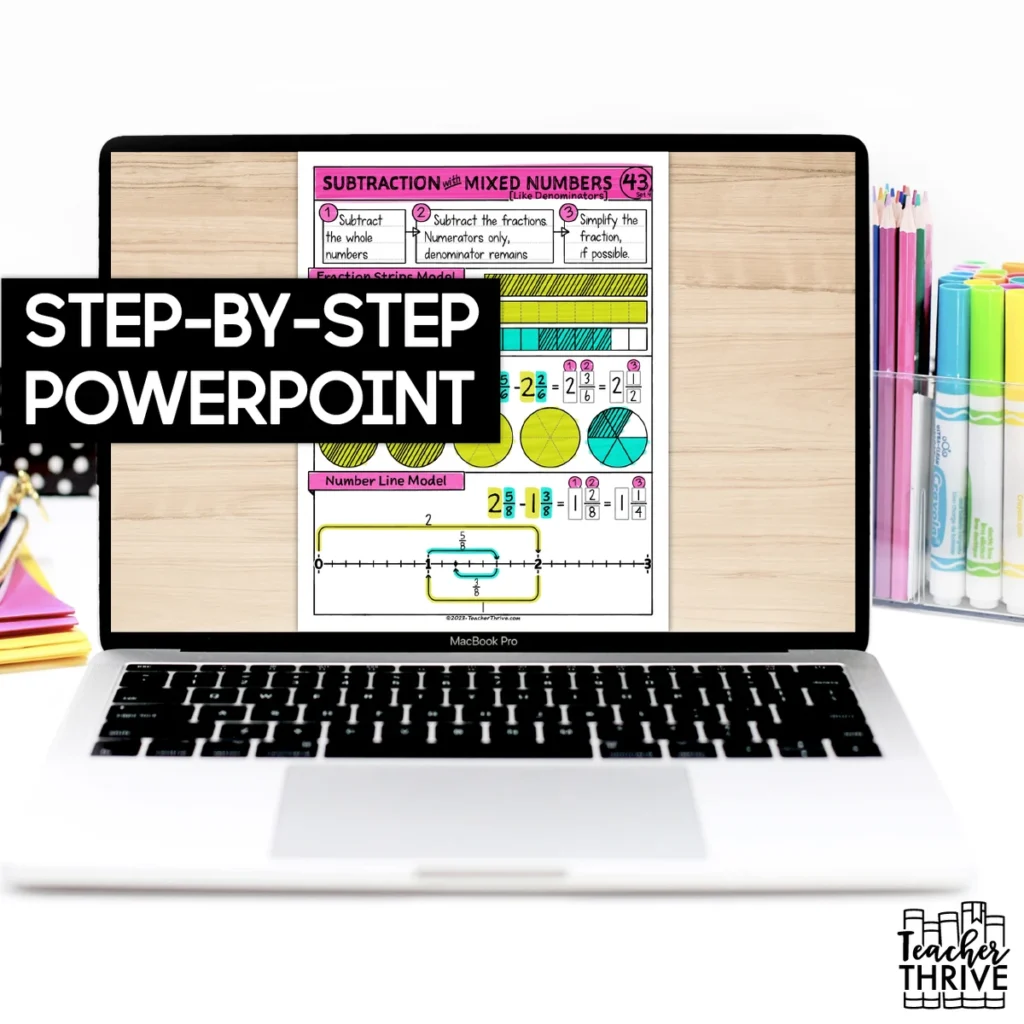
- Step-by-step PowerPoint
GUIDED NOTE-TAKING
Guiding your students through the note-taking process is so easy and requires almost zero preparation!
- PowerPoint: Each sketch note page comes with a step-by-step PowerPoint that you can use to guide your students as they complete their notes.
- Document Camera: Use a document camera to project a blank copy of the notes. Use the answer key provided to complete the note page in front of your students.
WHY SKETCH?
Sketch notes present your students with a meaningful and engaging activity they will love. Doodle note-taking activates verbal and visual modalities to capture concepts. The whole brain is absorbed in hearing, synthesizing, and retaining ideas. This high level of engagement helps students retain the content and leaves little room for distraction.
Click HERE for the entire 4th grade bundle of math sketch notes!
Get all the latest Teacher Thrive news!
➜FOLLOW me on Teachers Pay Teachers!
➜FOLLOW me on TeacherThrive.com!
Please read: This is a nonrefundable digital download. Please read the description carefully and examine the preview file before purchasing.
© Copyright 2018 M. Tallman. All rights reserved. Permission is granted to copy pages specifically designed for student or teacher use by the original purchaser or licensee. This is intended to be used by one teacher unless additional licenses have been purchased. The reproduction of any other part of this product is strictly prohibited. Copying any part of this product and placing it on the Internet in any form (even a personal/classroom website) is strictly forbidden. Doing so makes it possible for an Internet search to make the document available on the Internet, free of charge, and is a violation of the Digital Millennium Copyright Act (DMCA).
Reviews
Showing 5356–5360 of 5,409 reviews
Thanks
Thanks
A great resource for Intervention!
I like the set-up, but I have to go in and change several things b/c the exercises don't require the students to do what is required of the actual Common Core standard. Ex, students do know figurative language. The Daily Language wants the students to find the origin, meaning & write a sentence. The origin is not part of the standard. I feel it's better for the students to determine the meaning using context clues (instead of just looking it up), then write their own sentence. Instead, I give them a sentence using the idiom. Then they must determine, the meaning using the context clues I've provided in the sentence. Then they must write their own sentence using the idiom. I do the same thing for the proverb/adage on the Wednesday section.
The prefix section- I change it around & have the students to identify the prefix. Determine the meaning of the prefix, then then the meaning of the word. I do understand that when creating this product, it's created to serve teachers all over that may have different standard that they must follow. I'd like to send examples of how I tweak the Daily Language.
Hello. Thank you for taking the time to leave such detailed feedback. While the origin is not part of the standard, students find this information very interesting and knowing the origin does help students retain the meaning. I will also add that the act of finding the origin is a common core standard: "Consult reference materials (e.g., dictionaries, glossaries, thesauruses), both print and digital, to find the pronunciation and determine or clarify the precise meaning of key words and phrases." I am happy to hear that you have been able to adapt this resource to meet your teaching needs, though.
Kind of high expectations before reading -- concepts are challenging for many younger students with nothing concrete from which to build references. With the right group, it would be great.
Questions & Answers (0)
Have a question about this resource? Log in to ask a question.
No questions yet.
